At the GTC conference, NVIDIA announced three major updates: its flagship AI platform, Vera Rubin, has officially entered mass production, dispelling rumors of delays; it unveiled the Vera CPU, specifically designed for agent-based AI, which brings the sales value ratio of CPUs to GPUs closer to 1:1, directly challenging Intel and AMD; and it jointly launched with Microsoft the RTX Spark, a consumer-grade AI PC chip based on the ARM architecture. Citi views this as a positive signal and maintains its Buy rating with a $300 price target.
At today’s GTC conference, NVIDIA unveiled three key updates, effectively dispelling market concerns about its product roadmap and demonstrating that its business scope is expanding comprehensively from GPUs to CPUs and even into consumer-grade AI PCs.
CEO Jensen Huang announced that the flagship AI platform Vera Rubin has officially entered mass production, alleviating prior investor concerns about potential delays. Concurrently, NVIDIA introduced the Vera CPU, specifically designed for agentic AI, which significantly outperforms x86 competitors across major workloads; and jointly launched RTX Spark, a new generation of Windows PCs based on the ARM architecture, in partnership with Microsoft.
 According to ZhuiFeng Trading Desk, Citi Research analyst Atif Malik characterized these developments as “positive” signals. Particularly noteworthy is that the introduction of the Vera CPU indicates the historical sales value ratio between CPUs and GPUs—previously at 1:2—is shifting toward approximately 1:1, opening a new revenue growth avenue for NVIDIA.
Citi maintains its Buy rating on NVIDIA with a price target of $300, implying an upside of approximately 42% from the current share price of $211.14.
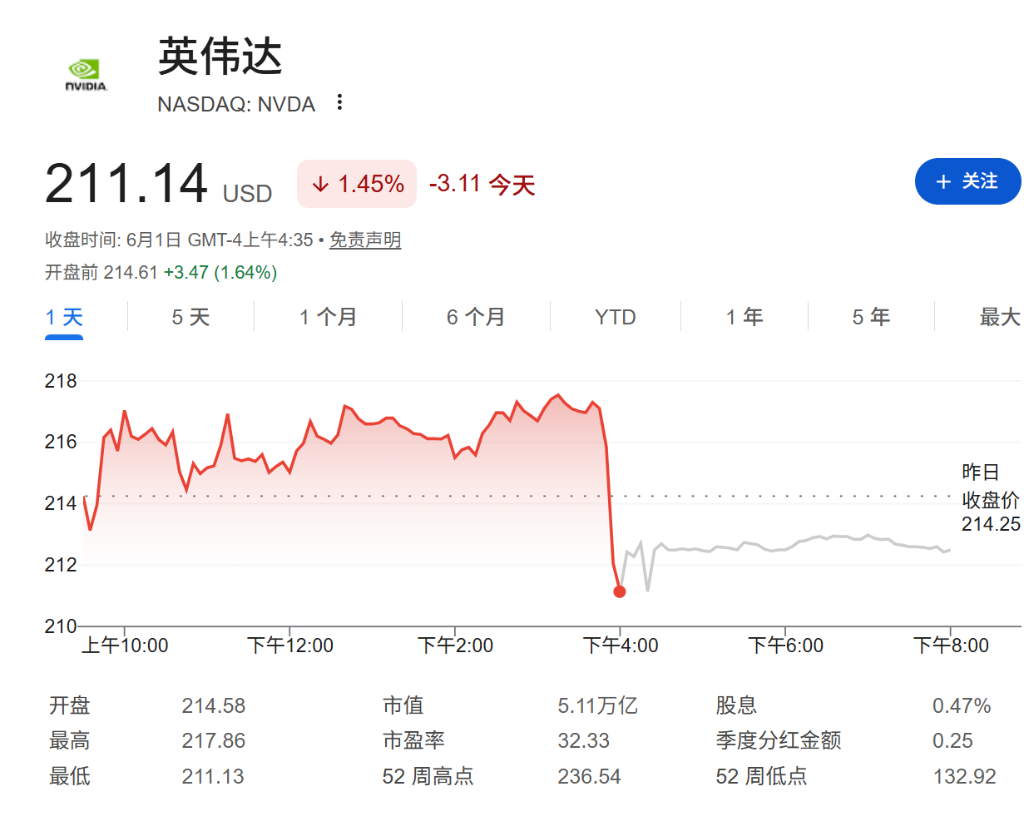
Mass production of Vera Rubin commences, putting delay rumors to rest
The announcement of mass production for the Vera Rubin platform was the most closely watched highlight of this year’s Computex. According to Citi Research, the market had previously harbored doubts about whether the platform could be delivered on schedule, and Jensen Huang’s public confirmation effectively resolved this uncertainty.
The Vera Rubin platform comprises five dedicated racks operating collectively as a single AI supercomputer, integrating the Vera Rubin NVL72 GPU system, Vera CPU, BlueField-4 STX storage, and Spectrum-6 networking. Compared to the previous-generation Blackwell platform, it delivers 10 times higher agent throughput at scale. Major server manufacturers and supply chain partners have already begun volume production of Vera Rubin–based systems, targeting AI laboratories, cloud service providers, and hyperscale data center operators.
Also entering mass production concurrently is NVIDIA’s Spectrum-X Ethernet photonics interconnect technology, which combines co-packaged optics with Spectrum-X switches to enable AI factory networking at million-GPU scale. Compared to networks using conventional transceivers, this solution offers 5x better energy efficiency, 5x longer AI runtime, and 1.3x faster deployment speed. CoreWeave, Microsoft, and OCI have become the first ecosystem partners.
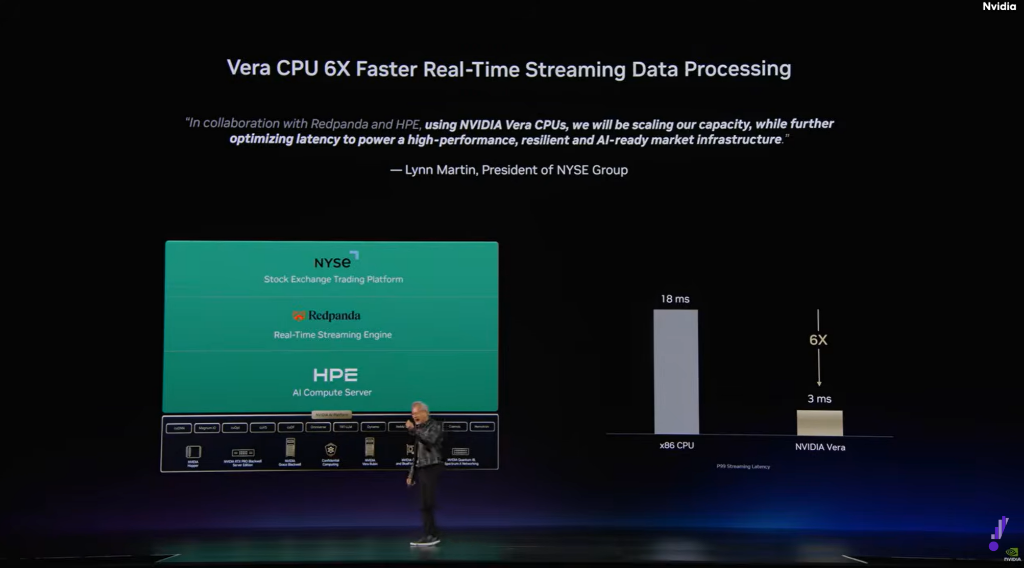
CPU strategy elevated—NVIDIA takes direct aim at AMD and Intel
The most surprising development for analysts at this year’s Computex was the strategic elevation of NVIDIA’s CPU business.
In his speech, Jensen Huang characterized the Vera CPU as the core bottleneck of the AI agent era: "In the age of AI agents, the CPU has become the bottleneck limiting GPU performance." The Vera CPU is purpose-built for AI agent workloads, delivering 3x higher performance than x86 counterparts (AMD/Intel) in SQL operations, 6x higher performance in data processing, and approximately 1.8x overall performance improvement over x86 in common agent tools such as Python, code analysis, and compilation.
Of greater significance is the evolving CPU-to-GPU ratio. Citi Research noted that historically NVIDIA sold one CPU for every two GPUs; however, with the surge in AI agent demand, the CPU-to-GPU ratio has now approached 1:1. NVIDIA has already launched a standalone CPU rack product comprising 256 CPUs, which also serves a memory expansion function, further enhancing its commercial value. To date, Vera CPU has secured Anthropic and OpenAI as early adopters.
Citi Research believes this development holds substantive implications for increasing NVIDIA’s overall system value, and that revenue contribution from its CPU business is likely to exceed prior market expectations.
A New Era for AI PCs: RTX Spark Targets the Consumer Market
In the personal computing segment, NVIDIA and Microsoft jointly unveiled the RTX Spark superchip, extending agentic AI capabilities to consumer-grade Windows devices.
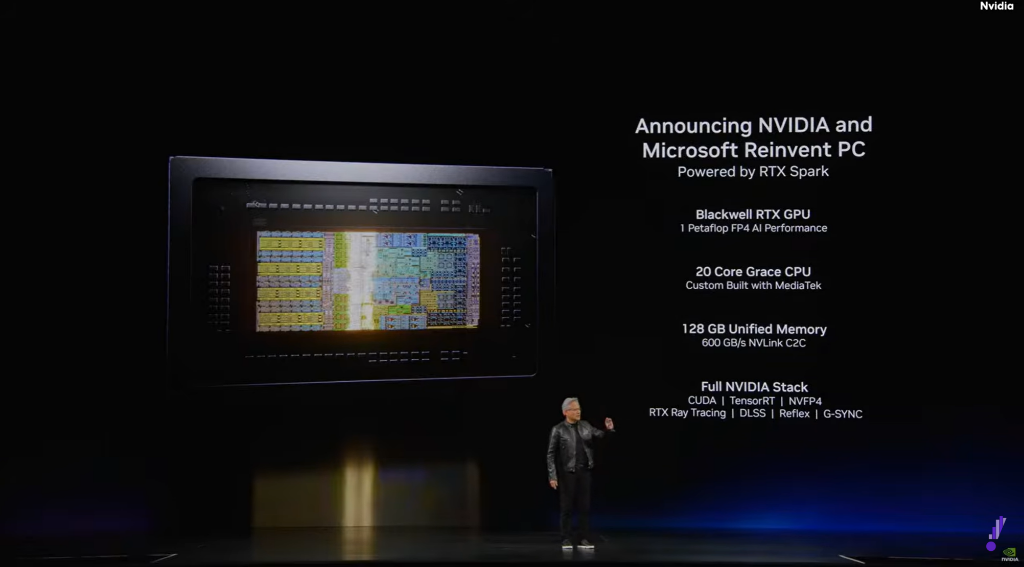
RTX Spark adopts an ARM architecture and directly connects a Blackwell RTX GPU to a 20-core Grace CPU—co-designed with MediaTek—via NVIDIA’s NVLink C2C, delivering 1 petaflop of AI compute performance and up to 128GB of unified memory. It is optimized for thin-and-light notebooks with all-day battery life and ultra-efficient compact desktops.
In terms of performance metrics, RTX Spark can render 3D scenes exceeding 90GB in size, edit video in 12K 4:2:2 format, run locally hosted large language models with 120 billion parameters supporting million-token context windows, and play AAA games at 1440p resolution with frame rates exceeding 100 FPS. NVIDIA stated that this product integrates three decades of core technological advancements, including CUDA, RTX, DLSS, FP4, TensorRT, and OptiX.
Citi Research described this launch as the dawn of a "new PC era," asserting that RTX Spark consolidates AI-powered content creation, gaming, and personal agent capabilities into a single consumer-grade device.